
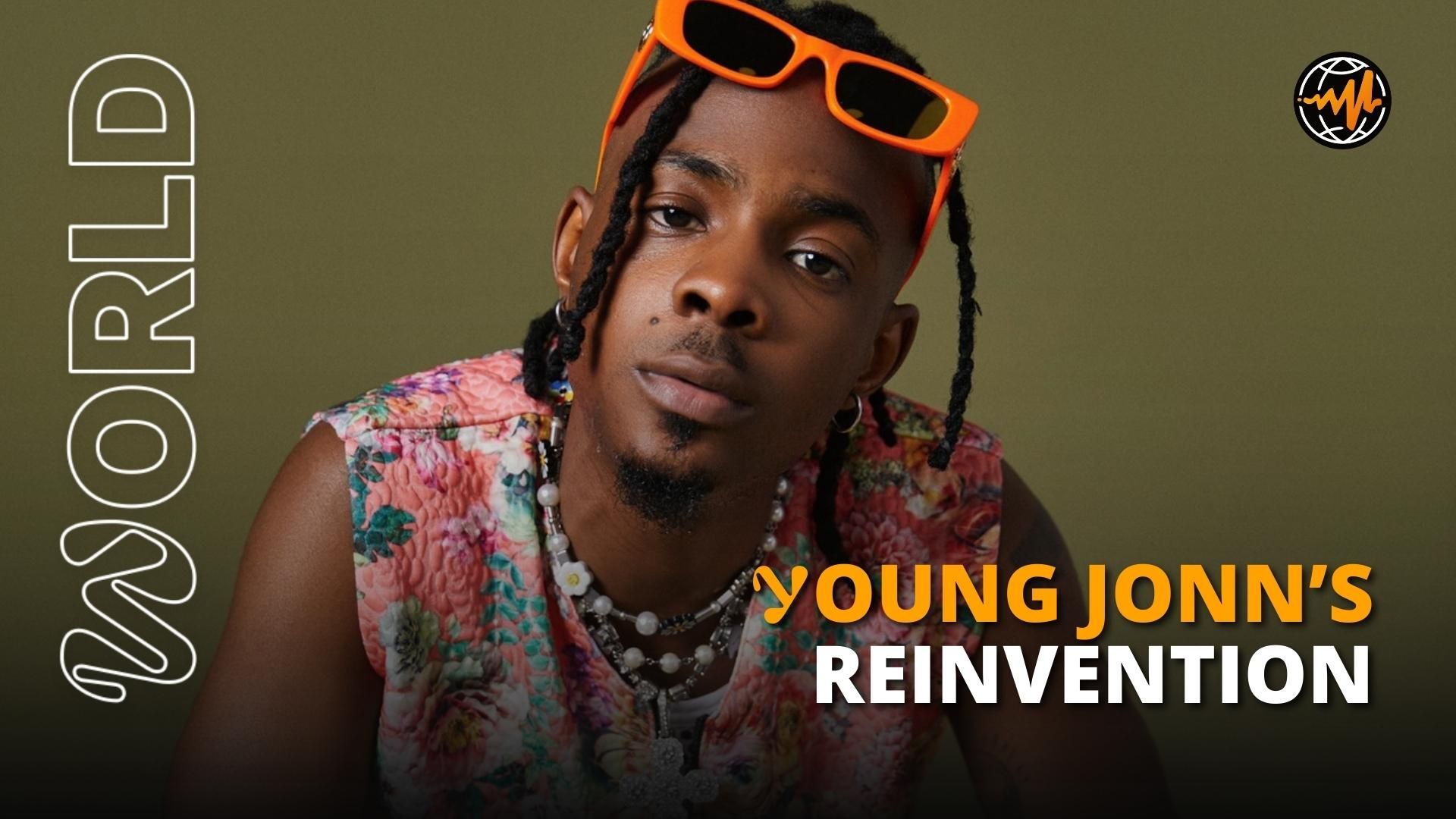

This article previously appeared on Audiomack World.
Producer-turned-singer Young Jonn has made a massive impact crafting songs for artists like Olamide, Kizz Daniel and Davido, but he initially planned on being the lead artist on his productions. “My purpose of learning how to produce was so I could produce for myself and my brothers,” he tells Audiomack World. “It was supposed to be something small for us, and I didn’t take myself seriously until the hits started rolling in.”
Over a decade later, Young Jonn’s career is coming full circle. His debut EP, Love is Not Enough, is a departure from his original sonic identity, leaving the snappy drums and gritty sound that marked his earlier work as the go-to producer for anthems soundtracking streets from Lagos to Enugu. The five-track EP is stripped down both emotionally and production-wise, providing Young Jonn with enough room to fully contemplate love. Diving in heart-first, he strikes the ideal balance between romantic yearnings and party anthems.
“I made Love Is Not Enough for myself,” he admits. “While I care about how people react to the song when listening to it, what matters to me is how I felt when I recorded each song. It’s like I’m finally getting to say what’s been on my mind for a while now.”

Many musicians credit the church as their introduction to making music. How has this part of your background influenced your sound?
My parents are pastors, so I grew up in a church surrounded by musical instruments. I played the drums, the keyboard, and a couple of other musical instruments, and that’s where I got the musical foundation I’ve developed over the years with practice.
If you listen to my music either as a singer or a producer, you’ll notice that a lot of my sound is driven by melodies, and I got that from my time in church. Most of the music we made in church was also heavy on easy-to-learn melodies. I also try to add as much soul as possible to my music. I got introduced to that type of sound in church. These two things are the most apparent influences the church has had on the music I make.
Your producer tag, “Young Jonn, the wicked producer,” became a club and radio staple in 2014 after a string of hits with Olamide. How did that musical relationship start?
When I first moved to Lagos, I used to hang out at this place called Hit Factory Studio alongside other producers like Pheelz. This was the same studio Olamide recorded his Baddest Guy Ever Liveth and YBNL albums, so I spent a lot of my time watching him and the other artists like Reminisce that came in to record.
Olamide eventually invited me to his place to work and record a couple of songs, but on my way out, I mentioned that I’d sent him a beat a while ago and didn’t get any feedback. He asked me to play one of them, which just happened to be the beat for “Story For The Gods.” Even though we had already recorded two songs that day, he asked me to load the beat up. Olamide recorded the chorus and first verse that day. By the next morning, he’d done the second verse, and the song was out some days after.
That’s when my life changed.
How so?
Everything happened so fast after “Story For The Gods” dropped. I knew it was Olamide, but I wasn’t expecting the song to have the impact it did when we dropped it. I’d done my part and moved on. It wasn’t until my phone started blowing up that I had to ask myself, “Is this for real?”
When did you realize you wanted to step away from the console and get behind the mic?
I’d always recorded music for myself. It was just for me. But somewhere along the line, as a producer, I retreated into my shell and stopped being outgoing. This solitary period allowed me to get reintroduced to different parts of myself and the things I really loved doing. I started to write and record more personal music that captured my mental space at the time. I also realized that I was enjoying the process.
After a while, I decided to give it a try publicly.
Why was this the right time?
I can’t really explain it. Before now, I wasn’t in the “I want to share my own music” space, mentally. But I recently found myself wanting to record more music and share it with the world. I think it’s just a feeling. I didn’t plan it. It just happened.

I noticed Love Is Not Enough had a tonal shift from the gritty street anthem sound you’re known for. The songs are still danceable, but the punches are heavier with the lyrics than the beat. What inspired this change?
I feel like Young Jonn the singer and Young Jonn the producer are two different people. Or maybe they’re not. As a singer, I’m more connected to my emotions and can share that easily through my music. Then again, generally, as an artist, my music reflects my mental space at that moment in time. The Young Jonn I was when those street and club anthems were made is different from the Young Jonn I was when I recorded Love Is Not Enough. That’s why the EP sounds different.
What changed?
In 2014, I was much younger and more outgoing, hanging out with friends and looking for the next popping thing or place to go. That’s when I made all those party hits. But I was alone a lot when creating Love Is Not Enough. It was mostly me, my thoughts and my feelings. It was calmer and moodier, so I could self-reflect and make something different.
When did it hit you that you’d unlocked a new fan base as an artist?
When my single “Dada” blew up. I’m not social, so I didn’t know the full impact the song had on the streets and clubs until I started receiving text messages, calls, and videos of people enjoying it. That’s when it finally hit me. People were getting into the song, and engagement on social media started skyrocketing. It felt like a surreal moment for me.
Talking about “Dada,” how did the remix with Davido happen?
Initially, the EP didn’t have any collaborations. “Dada” had already started making waves, and I had jokingly spoken about a remix with Davido, but we never did anything about it. And then “Dada” came on one night when I was hanging out with him in the club and we were vibing. Playfully again, we spoke about it and left the club to record the remix at his home studio. We set up the equipment and recorded that night.
How does approaching collaborations as a vocalist differ from working with other artists as a producer?
The two are supposed to be different, but they’re similar to me. Music is all about creation and feeding off energies. It works out as long as there’s a connection with the artist. I try not to force my collaborations because I can’t move forward if the vibe is not 100%.
By the way, I’m shocked you didn’t produce the whole EP yourself.
I didn’t go into this project thinking I’d work with producers or produce it all myself. I just went with the flow and stayed in the moment. I didn’t even know these were the songs that would make the project.
How I worked was I’d record a song; if I listened back and thought it was incomplete, I’d think about the right producer that’d complement the work I’d done. I hit up Niphkeys and Magic Sticks because I thought they were the right people for each song. For me, it’s collaboration over competition.

Do you miss being the producer in the background?
I like new journeys and challenges. This is all new to me, but I’m enjoying it. As a producer, I could make the beats and disappear, but now as an artist, I’m learning I have to be present for everything. It’s a lot, but I’m enjoying the new experience.
Is producing still part of your plan?
Yes. I’m a musician and not limited to producing or singing. I love to create. I feel like it’s a superpower to create something from scratch and bring it to life. I enjoy producing, and that’s not stopping anytime soon. I have a couple of songs I produced coming soon.
I’m just creating music and that’s what I was born to do.
By Conrad Johnson-Omodiagbe for Audiomack