
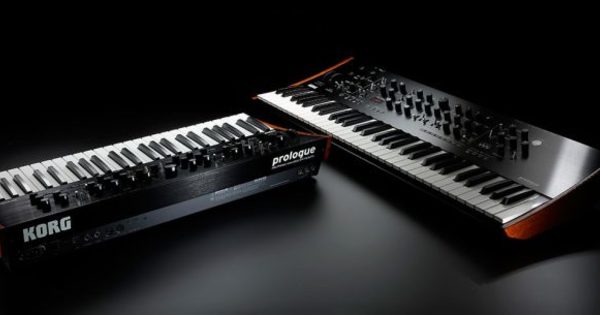

prologue is Korg’s brand new polyphonic analog synthesizer equipped with a full-sized keyboard. With powerful analog circuits that are descended directly from the earlier models of the series, together with a newly developed digital multi engine and gorgeous DSP-based effects, prologue expands the variety of sounds and the possibilities for user customization.
The lineup is comprised of two models that cover musicians’ needs for not only stage use, but also studio, home, or touring use: 16-voice 61-key prologue-16, and the eight-voice 49-key prologue-8. These instruments are capable of sounds that go beyond existing analog synthesizers.
The prologue is a successor to Korg’s Minilogue and Monologue synths that were released in 2015 and 2016, respectively. Powered by three different sound engines, the “prologue’s sonic potential [is] far beyond that of a traditional analog synthesizer.” It features four different voice modes: mono (produces only one note at a time), unison (creates a thick sound by layering multiple notes and playing them as a single note), poly (play multiple notes at once), or chord (play chords with one finger). It is also a two-timbre synth, so users can layer and play two patches (sounds) at the same time, crossfade between the two, or split them entirely.
Also, it comes with a powerful arpeggiator that has a range of four octaves, two digital effect units (modulation and delay / reverb), two envelope generators, one filter, and one LFO (used to modulate a sound for creating a rhythmic pulse or sweep). There are multiple ways to navigate through and organize the synth’s hundreds of patches, including the ability to mark your favorites, or see the ones you tend to use the most.
One of the things that’s most exciting about the Korg prologue is that it has a total of 32 free slots that allow for users to load in their own oscillators and effects. Korg says there is an upcoming software toolkit to be released in spring that will allow developers to “program, customize and extend the capabilities of the multi-engine and digital effects.”
Learn more about the Korg prologue here.